TLS Flaws Found in GoAhead Web Server Used in Hundreds of Millions of Devices
GoAhead, a web server used on hundreds of millions of devices across various sectors including IoT, OT, and military, has three TLS vulnerabilities disclosed by FoxIO.
GoAhead, a web server embedded in numerous devices like routers and printers, has two TLS vulnerabilities. Both vulnerabilities stem from misconfigurations and are addressed by GoAhead 6.1.1, but firmware updates are req…
A new Linux malware strain, dubbed ‘ClingSTUN,’ is exploiting a growing list of vulnerabilities in IoT devices to establish a persistent foothold on enterprise networks. Researchers have identified at least 24 vulnerabil…
A Linux backdoor, dubbed ClingSTUN, is abusing the STUN protocol to exploit dozens of vulnerabilities and establish a backconnect proxy.
A U.S. Army soldier, Cameron John Wagenius, was sentenced to 70 months in prison for hacking into multiple telecommunications companies, including AT&T and Verizon, and extorting them for stolen data. Despite his efforts…
Evooo1Bot, a Linux botnet derived from Mirai, has significantly expanded its capabilities beyond simple DDoS attacks. It now incorporates advanced features like encrypted C2 communications, SSH brute-force scanning, a re…
A new Linux botnet, dubbed Evooo1Bot, leveraging Mirai's code, is actively exploiting vulnerabilities in internet-facing devices to turn them into SOCKS5 proxies. The botnet utilizes a range of capabilities including enc…
A new, stealthier variant of the Mirai botnet, dubbed Evooo1Bot, has been actively exploiting vulnerabilities in internet-facing hardware for over a month. This malware boasts advanced features like encrypted communicati…
A new botnet, RustDuck, is leveraging Rust programming to hijack routers, IP cameras, and servers for DDoS attacks. Developed by QiAnXin's XLab, the botnet utilizes a two-stage approach, exploiting vulnerabilities in dev…
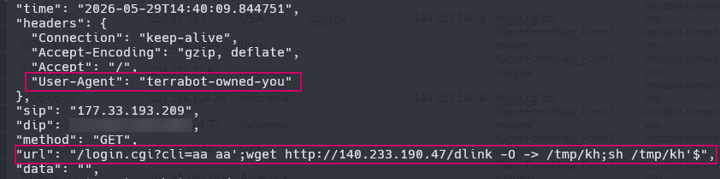
This SANS Internet Storm Center guest diary details an analysis of automated cybercrime activity observed through a honeypot, focusing on the Terrabot IoT botnet. The author, a BACS student, highlights the prevalence of…
A new malware family, dubbed AryStinger, is exploiting vulnerabilities in older Realtek RTL819X routers to create a reconnaissance network. Approximately 4,300 routers, primarily D-Link models, have been infected, scanni…
A new botnet, named AryStinger, has been discovered compromising over 4,000 outdated D-Link routers worldwide, turning them into proxies for malicious traffic. The malware utilizes multiple vulnerabilities to perform sca…